
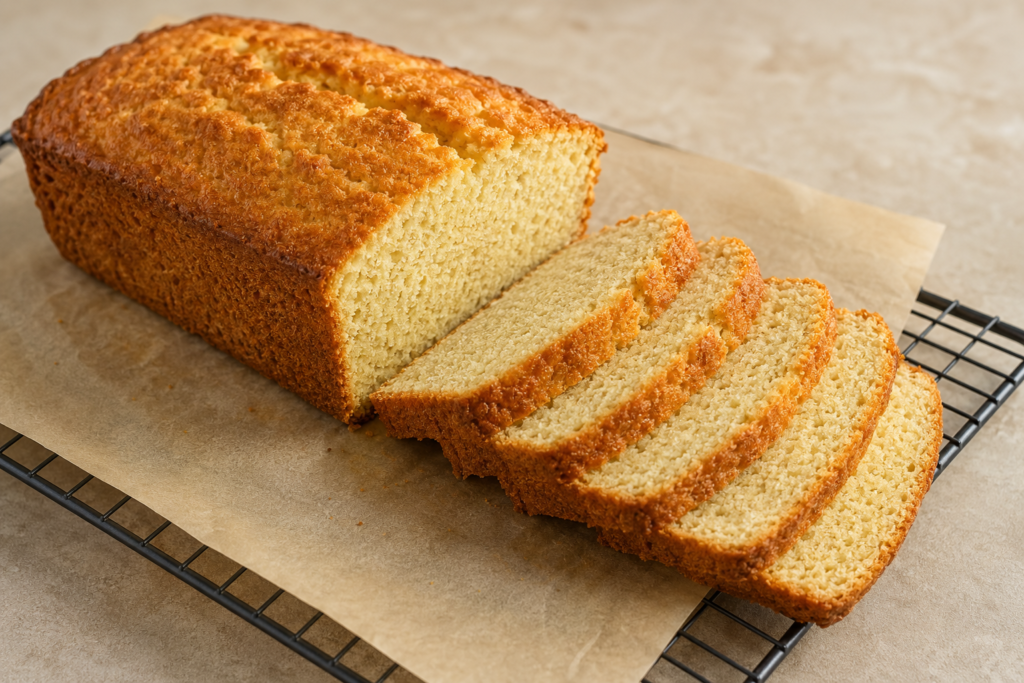
This almond flour keto bread recipe makes a mild, sturdy loaf that works for toast, sandwiches, and weekly meal prep. The crumb is soft rather than cakey, and using more egg whites than yolks keeps the flavor from tasting overly eggy.
Difficulty: Beginner | Prep: 15 minutes | Cook: 50 minutes | Total: 2 hours 5 minutes, including cooling | Servings: 12 slices | Net carbs: 2 g per slice | Protein: 9 g per slice | Base flour: Blanched almond flour | Egginess: Low | Best use: Toast and sandwiches | Texture: 9/10 | Freezer score: 9/10
Use the Jump to Recipe button for the complete method or Print Recipe to save the metric and US measurements. For the best result, weigh the dry ingredients, use an 8½-by-4½-inch (21 x 11 cm) metal pan, and let the loaf cool completely before slicing.
Recipe DNA
- Difficulty
- Beginner-friendly
- Prep / Cook / Total
- PT15M / PT50M / PT2H5M
- Servings
- 12 slices
- Net Carbs per Slice
- 2 g estimated
- Protein per Slice
- 9 g
- Base Flour
- Almond flour
- Egginess Level
- High / egg-forward
- Best Use Case
- Sandwiches and toast
- Texture Score
- 8/10: soft, sturdy, and lightly chewy
- Freezer Score
- 9/10
Jump to Recipe / Print Buttons
At a Glance
- Best for: toast, sandwiches, and meal prep
- Texture: soft, sturdy, and lightly chewy
- Flavor: mild and not eggy
- Best reader: beginners who want reliable keto bread
Why You’ll Love This Recipe
- At a glance — Best for toast, sandwiches, and make-ahead breakfasts; soft, sturdy, lightly chewy texture; mild flavor; designed for beginners who want dependable keto bread.
- Sturdy enough for fillings — Psyllium, egg whites, and protein isolate help the slices bend and hold together instead of crumbling.
- Low in carbs — Each of the 12 slices has about 8 g total carbs, 6 g fiber, and 2 g net carbs.
- Clear visual cues — The batter should be thick but spreadable, and the baked top should be golden, firm, and dry to the touch.
- Freezer-friendly — Individual slices can be frozen and reheated directly in a toaster or skillet.
Why This Recipe Works
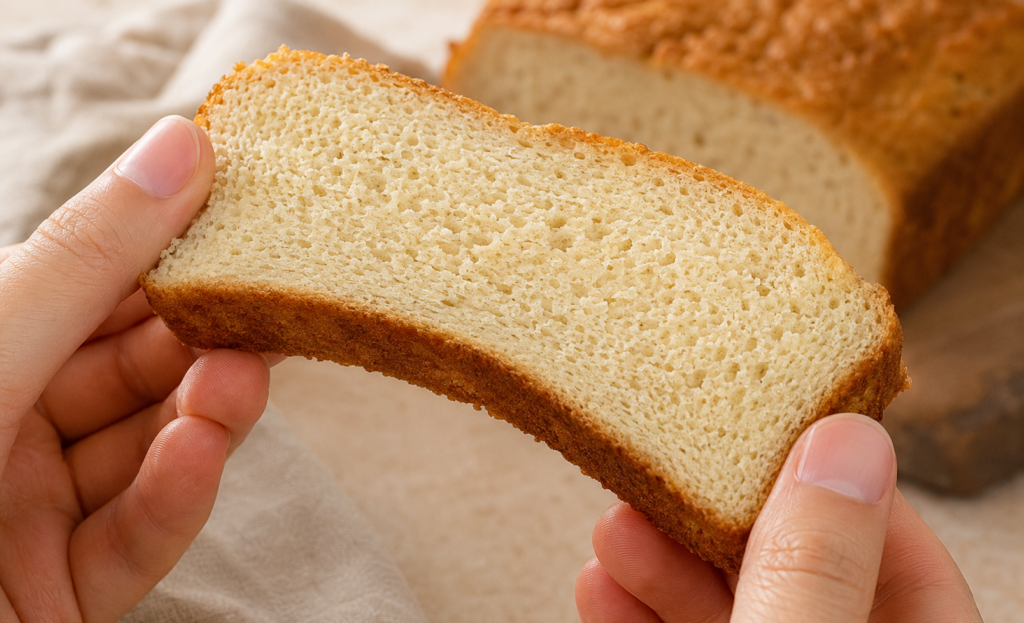
Finely ground blanched almond flour supplies fat and tenderness but does not contain gluten, so it needs added structure. Psyllium absorbs water and forms a flexible gel that helps the loaf hold its shape.
Unflavored whey protein isolate firms as it bakes, improving height and making the slices better for toast and sandwiches. Two whole eggs add richness, while four egg whites provide structure without a strong egg flavor.
Baking powder creates lift, and apple cider vinegar supports a lighter crumb. The loaf must cool completely because its interior continues to set as steam leaves; cutting it warm can compress the crumb and make it seem gummy.
Expected Results
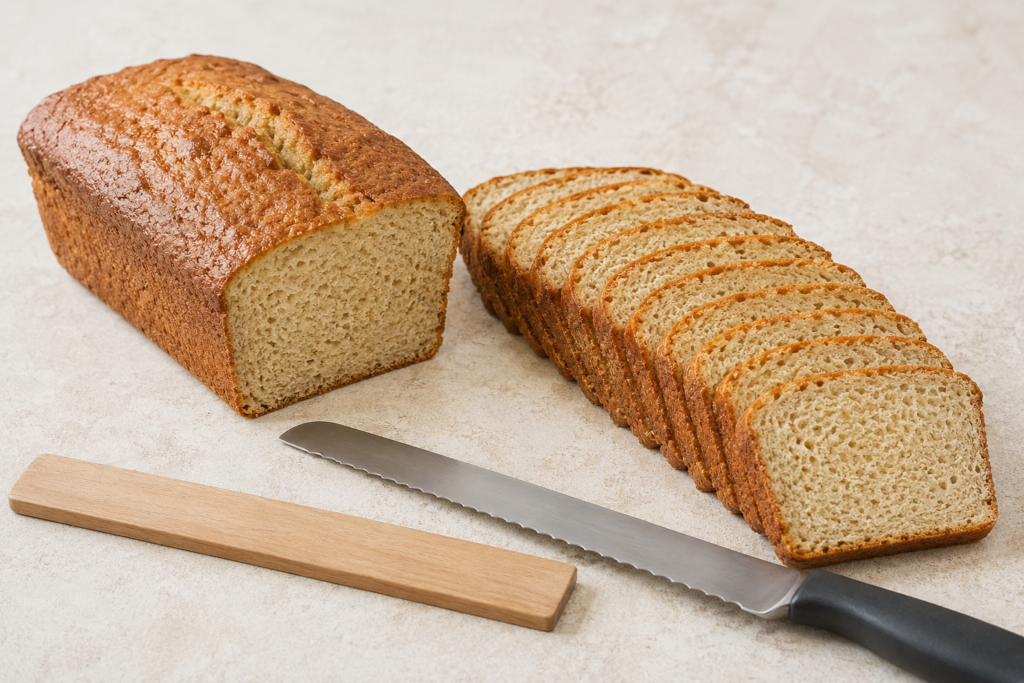
Expect a fully set loaf with an even crumb, clean slices, and the texture described in the recipe. Finished height and slice count depend on the exact pan, flour grind, and moisture level.
- An even crumb without a wet or gummy center
- A golden, set crust with cleanly cut slices
- The loaf is done when the center reaches 350°F / 177°C, and the top is golden and firm.
Ingredients & Substitution Matrix
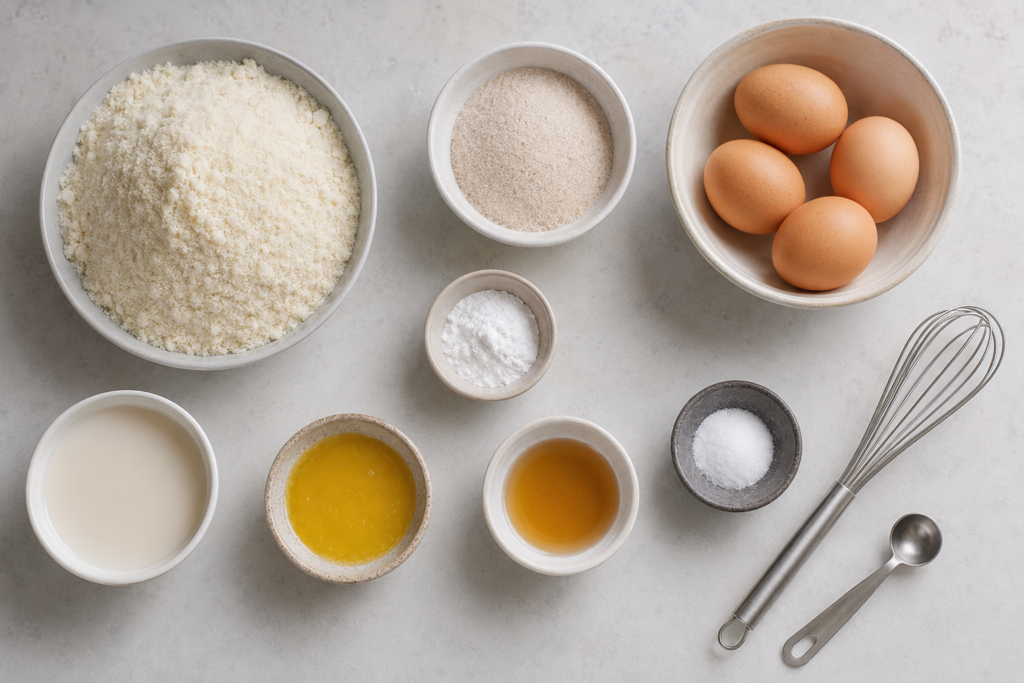
| Ingredient | Purpose | Approved Swap | DO NOT Swap |
|---|---|---|---|
| fine blanched almond flour, spooned lightly if not weighed | Structure and bulk | Sunflower seed flour by weight in tested recipes | Do not swap cup-for-cup with another keto flour |
| finely ground psyllium husk powder | Moisture and slice strength | Only tested recipe-specific swaps | Do not omit without changing liquids and binders |
| unflavored whey protein isolate | Flavor, moisture, or texture | Only tested recipe-specific swaps | Do not guess if it changes structure |
| baking powder | Rise | Only tested recipe-specific swaps | Do not guess if it changes structure |
| fine sea salt | Flavor, moisture, or texture | Only tested recipe-specific swaps | Do not guess if it changes structure |
| whole eggs, at room temperature | Binding and lift | Use a tested egg-free recipe | Do not guess if it changes structure |
| egg whites, at room temperature | Binding and lift | Use a tested egg-free recipe | Do not guess if it changes structure |
| unsalted butter, melted and cooled slightly | Flavor, moisture, or texture | Avocado oil or melted coconut oil | Do not guess if it changes structure |
Critical Equipment & Before You Start
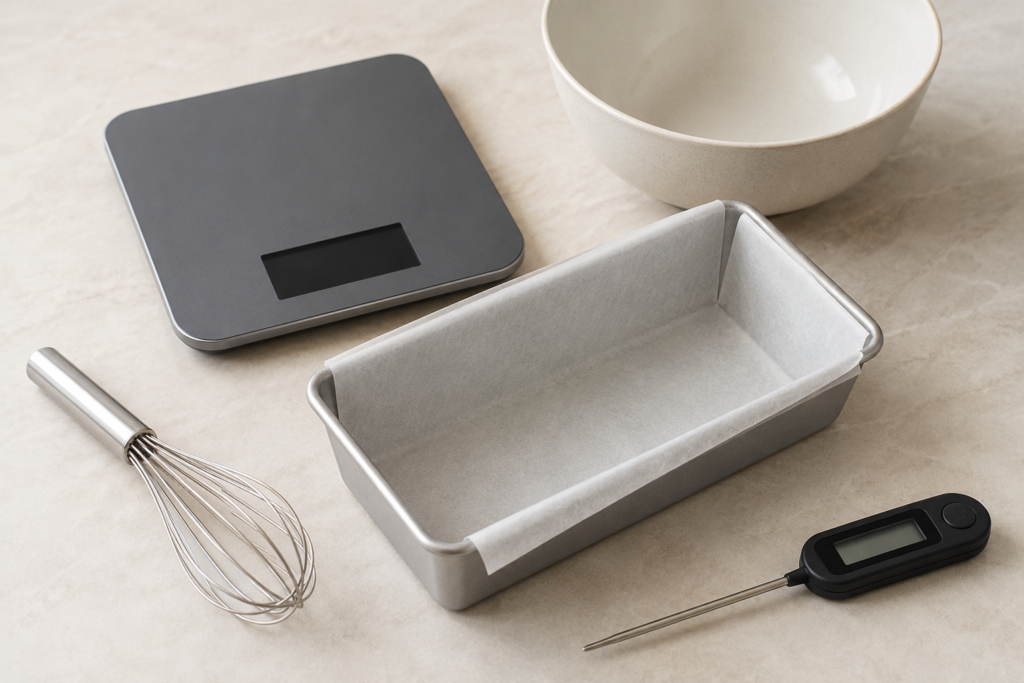
Use a digital scale, the exact loaf pan or appliance specified by the recipe, parchment, a mixing bowl, and an oven thermometer when accuracy matters.
- Bring temperature-sensitive ingredients to room temperature.
- Measure dry ingredients by weight and show both US and metric quantities.
- Confirm the pan size in inches and centimeters.
- Preheat the oven fully and confirm temperatures in Fahrenheit and Celsius.
- Plan to cool the loaf completely before slicing.
Step-by-Step Instructions
Image plan: Action photos showing thick but spreadable batter, a golden firm top, and the fully cooled loaf.
- Heat the oven to 350°F / 177°C with a rack in the center. Lightly grease an 8½-by-4½-inch (21 x 11 cm) metal loaf pan and line its long sides and base with parchment, leaving handles for lifting.
- Whisk 2 cups (224 g) almond flour, 3 tablespoons (24 g) psyllium husk powder, ¼ cup (30 g) whey protein isolate, 1 tablespoon (12 g) baking powder, and ¾ teaspoon (4 g) salt in a large bowl. Break apart every visible lump so the leavener and psyllium are evenly distributed.
- In a second bowl, whisk 2 whole eggs (100 g), ½ cup (120 g) egg whites, ¼ cup (57 g) melted butter, ½ cup (120 ml) warm water, and 1 teaspoon (5 ml) apple cider vinegar until smooth and lightly foamy, with no streaks of egg white.
- Pour the wet mixture into the dry ingredients. Stir for 45–60 seconds, scraping the bottom, until no dry pockets remain. Let the batter stand for 3 minutes; it should become thick but spreadable and should mound softly on a spoon rather than pour like cake batter.
- Transfer the batter to the prepared 8½-by-4½-inch (21 x 11 cm) pan. Press it into the corners, smooth the top with a damp spatula, and tap the pan twice on the counter to release large air pockets. The batter should sit in an even, gently domed layer.
- Bake at 350°F / 177°C for 45–55 minutes. At 35 minutes, loosely cover the loaf with foil if it is already deep golden. It is done when the top is golden and firm, a skewer has no wet batter, and the center reaches 200–205°F (93–96°C).
- Cool the loaf in the pan for 10 minutes. Lift it out using the parchment and place it on a wire rack for at least 60 minutes. The sides should feel dry and the loaf should be completely cool before slicing into 12 pieces with a serrated knife.
Pitfalls & Visual Troubleshooting
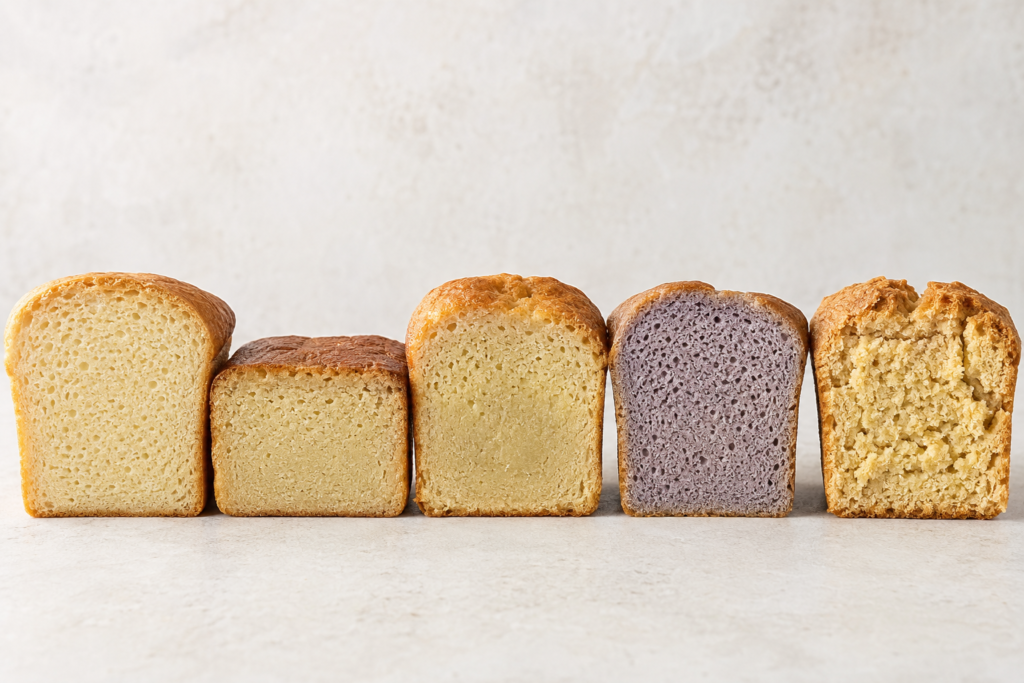
Image plan: Good loaf vs dense, gummy, purple, or crumbly loaf.
| Problem | Likely Cause | Fix |
|---|---|---|
| Dense, short loaf | Almond flour was packed into a cup, leavener was old, or the pan was too large | Weigh 2 cups (224 g) almond flour, test the baking powder, and use an 8½-by-4½-inch (21 x 11 cm) pan |
| Gummy center | The loaf was underbaked, sliced warm, or made with too much psyllium | Bake to 200–205°F (93–96°C), weigh 3 tablespoons (24 g) psyllium, and cool for at least 60 minutes |
| Purple or gray crumb | The psyllium brand changed color during baking | Use a light-colored baking-tested psyllium powder; the color is usually cosmetic |
| Crumbly slices | The psyllium was omitted, liquid was reduced, or the loaf was cut before setting | Use the full ½ cup (120 ml) water and 3 tablespoons (24 g) psyllium, then cool completely |
| Dark top with a wet middle | The pan was too close to the upper element or the oven ran hot | Bake on the center rack at 350°F / 177°C and loosely tent with foil after 35 minutes |
| Large tunnels through the crumb | The batter was overmixed after thickening or air pockets remained in the pan | Spread gently, press batter into the corners, and tap the filled pan twice before baking |
Master Recipe Card
A beginner-friendly almond flour keto bread with a mild flavor, golden crust, and flexible crumb that holds up to toast and sandwich fillings.
Ingredients
- 2 cups (224 g) fine blanched almond flour, spooned lightly if not weighed
- 3 tablespoons (24 g) finely ground psyllium husk powder
- ¼ cup (30 g) unflavored whey protein isolate
- 1 tablespoon (12 g) baking powder
- ¾ teaspoon (4 g) fine sea salt
- 2 large (100 g without shells) whole eggs, at room temperature
- ½ cup (120 g), about 4 large egg whites, at room temperature
- ¼ cup (57 g) unsalted butter, melted and cooled slightly
- ½ cup (120 ml) warm water, about 105°F / 41°C
- 1 teaspoon (5 ml) apple cider vinegar
Steps
- Heat the oven to 350°F / 177°C with a rack in the center. Lightly grease an 8½-by-4½-inch (21 x 11 cm) metal loaf pan and line its long sides and base with parchment, leaving handles for lifting.
- Whisk 2 cups (224 g) almond flour, 3 tablespoons (24 g) psyllium husk powder, ¼ cup (30 g) whey protein isolate, 1 tablespoon (12 g) baking powder, and ¾ teaspoon (4 g) salt in a large bowl. Break apart every visible lump so the leavener and psyllium are evenly distributed.
- In a second bowl, whisk 2 whole eggs (100 g), ½ cup (120 g) egg whites, ¼ cup (57 g) melted butter, ½ cup (120 ml) warm water, and 1 teaspoon (5 ml) apple cider vinegar until smooth and lightly foamy, with no streaks of egg white.
- Pour the wet mixture into the dry ingredients. Stir for 45–60 seconds, scraping the bottom, until no dry pockets remain. Let the batter stand for 3 minutes; it should become thick but spreadable and should mound softly on a spoon rather than pour like cake batter.
- Transfer the batter to the prepared 8½-by-4½-inch (21 x 11 cm) pan. Press it into the corners, smooth the top with a damp spatula, and tap the pan twice on the counter to release large air pockets. The batter should sit in an even, gently domed layer.
- Bake at 350°F / 177°C for 45–55 minutes. At 35 minutes, loosely cover the loaf with foil if it is already deep golden. It is done when the top is golden and firm, a skewer has no wet batter, and the center reaches 200–205°F (93–96°C).
- Cool the loaf in the pan for 10 minutes. Lift it out using the parchment and place it on a wire rack for at least 60 minutes. The sides should feel dry and the loaf should be completely cool before slicing into 12 pieces with a serrated knife.
Nutrition
178 kcal calories; 15 g fat; 8 g total carbs (2 g net carbs) total carbs; 6 g fiber; 9 g protein. Nutrition is an estimate.
Recipe Variations
- Garlic: Add 1 teaspoon (3 g) garlic powder and 1 tablespoon (4 g) dried parsley to the dry ingredients.
- Cheese: Fold ½ cup (56 g) finely shredded sharp cheddar into the finished batter. Check doneness at 50 minutes because the added moisture may extend baking.
- Sweet cinnamon: Add 2 tablespoons (24 g) granulated keto sweetener, 1 teaspoon (3 g) cinnamon, and 1 teaspoon (5 ml) vanilla extract. Use unflavored protein powder with no savory seasoning.
- Herb: Add 1 teaspoon (1 g) dried rosemary and 1 teaspoon (1 g) dried thyme to the dry mixture. Crush the herbs between your fingers before adding.
Storage, Freezing & Reheating
- Storage: — Keep the completely cooled loaf in an airtight container in the refrigerator for up to 5 days, placing parchment between slices if needed. Freezing — Freeze individual slices in a single layer, then transfer them to a freezer bag for up to 3 months. Separate slices with parchment for easy removal. Reheating — Toast refrigerated or frozen slices until the edges are crisp, or warm each side in a dry skillet over medium-low heat for 1–2 minutes. Do not microwave for too long or the crumb may become rubbery.
- Freezing: — Freeze individual slices in a single layer, then transfer them to a freezer bag for up to 3 months. Separate slices with parchment for easy removal. Reheating — Toast refrigerated or frozen slices until the edges are crisp, or warm each side in a dry skillet over medium-low heat for 1–2 minutes. Do not microwave for too long or the crumb may become rubbery.
- Reheating: — Toast refrigerated or frozen slices until the edges are crisp, or warm each side in a dry skillet over medium-low heat for 1–2 minutes. Do not microwave for too long or the crumb may become rubbery.
FAQ
Can I make this almond flour keto bread without psyllium husk?
Not as a direct substitution. The 3 tablespoons (24 g) of psyllium hold water and keep the almond flour loaf flexible. Omitting it would require a separately tested balance of eggs, liquid, and another binder.
Why does my almond flour bread taste eggy?
A strong egg flavor usually comes from formulas that use many whole eggs. This recipe uses 2 whole eggs (100 g) plus ½ cup (120 g) egg whites for structure with fewer yolks. Cooling and toasting also soften the egg aroma.
Can I replace almond flour with coconut flour?
No. Coconut flour absorbs far more liquid than almond flour, so it cannot replace the 2 cups (224 g) of almond flour cup for cup or gram for gram.
How do I know the center is fully baked?
The top should be golden and firm, and a skewer should show no wet batter. For the most reliable check, the center should register 200–205°F (93–96°C) on an instant-read thermometer.
Can I use a 9-by-5-inch pan?
Yes, but the loaf will be shorter and may bake a few minutes faster. Begin checking at 42 minutes. An 8½-by-4½-inch (21 x 11 cm) pan gives the best sandwich-style height.
Why must the loaf cool before slicing?
The crumb is still setting as steam escapes. Slicing while warm can compress the loaf, create gummy-looking patches, and make otherwise sturdy slices crumble.